
Book Review:
Ascetics as Activists: Saffron Women of Hindu Nationalism by Koushiki Dasgupta, London, Bloomsbury Publication, 2025 , 201 pp., $80.50 (Hardback), ISBN:978-1-3504-4898-8
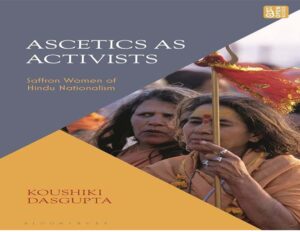
- Overview and Central Thesis
Ascetics as Activists offers a timely, ambitious intervention into the scholarship on gender, religion, and right-wing politics in modern India. Dasgupta tackles a seemingly contradictory phenomenon: the active participation of celibate female renouncers in a movement that is widely described as authoritarian, majoritarian, and deeply patriarchal. Rejecting binary frameworks that cast such women either as passive victims of tradition or as fully empowered agents of liberation, the book argues for a nuanced understanding of “constrained,” “negotiated,” or “performative” agency. Dasgupta shows that, yet they do so without fundamentally challenging the Brahmanical-patriarchal order, and often while reinforcing it. The central paradox is thus not an anomaly but the very logic of Hindutva’s gendered mobilization.
- Theoretical and Historiographical Foundations
The book situates itself within feminist scholarship that has critically examined women’s participation in conservative movements (Saba Mahmood, Tanika Sarkar, Urvashi Butalia, Paola Bacchetta). Dasgupta distances himself from liberal or left-leaning narratives that dismiss such participation as “false consciousness” or family pressure. Instead, drawing on Mahmood’s concept of agency within pious traditions, he argues that submission to dharma can coexist with public activism and subjective empowerment.
Historically, the introduction traces Hindu nationalism from nineteenth-century revivalism through V.D. Savarkar’s Hindutva (1923) and the RSS (Rashtriya Swayamsevak Sangh) to the Ram Janmabhoomi movement of the 1980s–90s. Dasgupta highlights how Hindutva has traditionally assigned women symbolic roles – as embodiments of purity, chastity, and cultural continuity – while selectively permitting militant public roles (e.g., reimagining Rani Laxmibai as a desexualized warrior). The post-1990s mainstreaming of Hindutva, particularly through televised Ram katha (the story of Ram) and mass mobilizations, expanded women’s presence in ways that both challenged and reinforced traditional expectations. Moreover, the Hindutva movement recognised women’s unique potential as conduits for disseminating ideology to families and children, thereby extending its reach into the domestic sphere.
Chapter 1 – The Enigma of Asceticism and Politics in India: Conceptual Underpinnings
This opening chapter provides a sophisticated conceptual history of Indian asceticism. Dasgupta shows that the ideal of vairagya (renunciation) has never been static; from Vedic and Sramaṇic traditions to colonial anti-British militancy, asceticism has repeatedly been repurposed for socio-political ends. The chapter excels in its interdisciplinary reach – integrating textual analysis (Rig Veda, Upanishads), anthropology (Dumont, Khandelwal), and political history (Vivekananda, RSS). Particularly valuable is the discussion of the Rashtra Sevika Samiti as a “political experiment” that reconciled ascetic virtues with public activism. However, Dasgupta overlooks a telling linguistic detail: the parent organization, the Rashtriya Swayamsevak Sangh (RSS), carries the term swayam (self), yet this is absent from the women’s wing – Rashtra Sevika Samiti. Both share the same abbreviation, RSS, raising questions about whether this was intentional or coincidental. Such naming strategies allow ideologues to assert association when convenient and deny it when the women’s wing becomes politically troublesome. This omission reflects a broader limitation: Dasgupta does not interrogate how symbolic erasures within Hindutva’s own institutional lexicon reinforce gendered hierarchies. Additional minor limitations include the dense, citation-heavy prose that may slow non-specialist readers, and the relatively brief treatment of non-Hindu ascetic traditions (Jain, Buddhist).
Chapters 2 & 3 – Caste, Gender, and Radical Leadership
These two chapters work as a pair. Chapter 2, “Negotiating Caste, Gender and Religion,” uses the career of Uma Bharti (former BJP Chief Minister of Madhya Pradesh) to expose caste as an unresolved tension within Hindutva’s claim to unity. Born into a Lodhi family – a caste classified under OBC (Other Backward Classes), which in Brahmanical terms is considered Sudra (the fourth and lowest varna in the Brahminical four-varna classification) – Bharti used her ascetic persona to gain political legitimacy, yet remained marginalized within upper-caste-dominated party structures. Dasgupta effectively shows that the BJP’s “social engineering” strategy incorporates lower-caste leaders without redistributing real power.
However, the positioning of Uma Bharti should be seen as a strategy and a medium to attract and communicate with lower-caste women specifically, and the OBC population in general – the largest section among Hindus. This was particularly aspirational in the wake of the Mandal Commission, which granted reservations to OBCs. Hindutva’s promotion of OBC leaders like Bharti was an attempt to keep the OBC bloc united and prevent it from consolidating behind secular or Dalit-led political formations. OBCs became the foot soldiers of the movement, even as they were rarely allowed to become flag bearers of real power. This dynamic – mobilization without structural inclusion – is embedded in gendered and caste dimensions, and could have been highlighted more systematically by the author
Chapter 3, “Chapter 3, “Exploring the Leadership and Narratives of the Radical Sadhvis,” focuses on figures like Sadhvi Rithambara (from Punjab, though the author does not mention her caste) and Niranjan Jyoti (a Dalit woman from Uttar Pradesh). Dasgupta analyses how militant religio-political rhetoric constructs a new feminine subjectivity – simultaneously maternal and violent. Through close reading of Rithambara’s speeches, he demonstrates how the collective “we” is mobilized to incite participation and normalize communal violence. These “radical sadhvis” expand women’s public roles without dismantling existing hierarchies.
However, the author does not elaborate on the venom in Rithambara’s speeches – the explicit hatred and incitement to violence against Muslims. The reader is told that the rhetoric is radical, but the actual content of that radicalism remains underexamined. Moreover, a crucial historical context is missing: whether Uma Bharti or Rithambara, both became known faces only after the demolition of the Babri Masjid in 1992. Their contributions before that moment are not established, suggesting that their rise was less about organic ascetic authority and more about the political opportunities unleashed by the Ram Janmabhoomi movement.
The chapter has rich empirical grounding and is sensitive to intersectionality (caste, class, and region).The theoretical framework remains implicit – Bourdieu on symbolic capital or Butler on performativity could have been deployed more systematically. Also, the voices of marginalized women themselves (Dalit or Muslim women affected by Hindutva violence) are largely absent, which risks a one-sided account. Finally, the omission of detailed hate speech analysis and the pre-1992 trajectories of these figures weakens the historical argument.
Chapter 4 – “Celibacy, Sexuality and Extremism: The Ascetic Warriors of Hindu Rashtra”
This is arguably the book’s sharpest analytical chapter. . Dasgupta argues that Hindutva does not merely regulate female sexuality; it weaponizes it. He identifies a triadic construction: women are simultaneously (1) the source of male nationalist anxiety, (2) perpetual victims of the “hyper-masculine” Muslim Other, and (3) embodiments of mātṛ-śakti (divine maternal energy). Celibacy becomes the ideological shield that allows sādhvīs to adopt masculine-coded militancy while remaining “pure.” Case studies of Sadhvi Pragya Singh Thakur (a prime accused in the 2008 Malegaon blasts and upper caste women) and Trikal Bhavanta (founder of the all-women Pari Akhara) illustrate how the BJP/Sangh Parivar alternately celebrates, distances itself from, and reabsorbs these “extremist” figures for electoral convenience. The chapter’s only weakness is its narrow comparative scope: similar celibate-militant female figures appear in Buddhist or Islamic fundamentalist contexts, but Dasgupta does not engage these parallels.
Chapter 5 – Sadhavi Shakti in Hindutva Politics.
This is the book’s longest and most empirically dense section. It examines the internal diversity of female asceticism—ranging from independent renouncers to monastic affiliates and social activists. A key finding is that even seemingly autonomous sadhvis remain dependent on guru-parampara (teacher-student lineage))rather than individual spiritual knowledge, making ascetic agency a form of “caged freedom.” Most female ascetics hail from northern India and belong to Saiva or Vaiṣṇava sects; the Juna Akhara (largest sub-branch of the Dasanami order) and the Kumbh Mela serve as primary initiation sites, yet reliable data on numbers remain inaccessible due to institutional secrecy.
The chapter traces how post-1990s politics—particularly the Ram Janmabhoomi movement—catapulted female ascetics into public visibility through their association with the Vishva Hindu Parishad (VHP) and the Sangh Parivar. This political turn generated symbolic inclusion: in 2019, 221 Dalit women and five transgender persons were appointed mahamaṇḍalesvars. Simultaneously, modern religious orders (Ramakrishna Mission, Brahma Kumaris) have accommodated women as spiritual leaders, though within separate, hierarchical structures.
Crucially, the author demonstrates that regardless of formal affiliation—whether directly with Hindutva organizations or with independent monastic orders—female ascetics exhibit a strong ideological convergence: the protection of Hindu culture, the positioning of women as mothers and custodians of tradition, and the construction of a collective “we” (ascetics and devout Hindus) against internal disunity and external threats (Islam, Christianity). They frame their work not as politics but as a spiritual mission to revive sanatana dharma. This discourse mutes caste oppression, untouchability, and gender violence, blaming Western materialism instead.
The chapter introduces the Sadhvi Shakti Parishad (SSP), established in 1998 as a VHP wing, as a key instrument for mobilizing female ascetics. Initially a cultural outlet, the SSP evolved into a political tool to equate Hindutva with sanātana dharma. The Ram Janmabhoomi movement—featuring Uma Bharti and Sadhvi Rithambara—taught the Sangh Parivar that aggressive, celibate, militant sādhvīs could reach household women, transport violence into everyday life, and offer an “alternative feminism” that rejects Western liberal models. Celibacy functions as ideological legitimacy, allowing sādhvīs to adopt masculine-coded warrior traits (modeled on Durga) while remaining chaste and trustworthy.
The author concludes that female asceticism is not a homogeneous category. Wandering ascetics differ from monastic or SSP-affiliated ones. Yet nearly all internalize Brahmanical-patriarchal norms, avoid critiquing caste or sexual exploitation, and serve as advocates of patriarchy under the guise of Vedic feminism. Their activism thus operates as a form of “false consciousness”—empowerment without structural transformation, mobilized for Hindutva’s majoritarian project.
Chapter 6 & Conclusion – Media, Market, and Technology
The final substantive chapter shifts from militant Hindutva sadhvis to “sanatani sadhvis”—traditional ascetics affiliated with monastic orders who operate at the intersection of digital spirituality and soft Hindutva. Dasgupta argues that post-1990s economic liberalization created a religious marketplace in which figures like Mata Kankeswari use YouTube, television, and social media to propagate sanatana dharma without overt electoral politics. Through Ram Katha, cow service, and strategic humility, they perform ritual knowledge and re-sacralize the nation. This “neo-sanghanist” Hindutva universalizes Hindu identity while muting caste contradictions; bhakti becomes a path that asks devotees to forget caste-based oppression, effectively silencing caste critique.
A crucial omission in Dasgupta’s analysis is the state’s role. While the advancement of Hindu culture is typically attributed to the BJP and the right wing, it is noteworthy that the Congress government, through state-mediated television broadcasts of Ramayana and Mahabharat, actively sacralized Hindu consciousness. Thus, the development of the Hindu ecosystem began during Congress rule, which provided a congenial space for right-wing ideologies to breathe and flourish—socially and politically. Congress was clandestinely deeply involved, yet the BJP emerged as the flagbearer, largely due to its strategic expansion among OBC constituencies. Consequently, the Indian state has long been favorably disposed toward Hindu cultural ideology, even if the BJP is perceived as its primary political beneficiary. Dasgupta’s neglect of this continuity—from Congress-era sacralization to contemporary sadhvi-led soft Hindutva—limits the analysis. While the book insightfully maps post-liberalization media ecologies and the rise of sanatani sadhvis, it overlooks how state-sponsored Hinduization predates and enables the very conditions it examines. This historical amnesia weakens an otherwise valuable contribution.
The Conclusion synthesizes the book’s entire arc: female ascetics are neither peripheral curiosities nor uniform foot soldiers but complex mediators who, through media and market logics, help reconfigure Hindu nationalism for the twenty-first century – blending tradition with technology while preserving its core majoritarian logic, ultimately in service of regaining political power. This book is an attempt to counter left feminism, first by debunking it and then by situating a “Vedic feminism” – defined in the name of culture but inherently patriarchal and embedded in Brahmanical ideology justified through the Vedas. It is an effort to occupy an epistemological space, not necessarily to demonstrate ascendancy but to justify and validate that space. These ascetics are seen by the author as “activists” precisely because they have been carefully shaped to maintain caste homogeneity and to facilitate the reach of political power. The inclusion of Dalit, Sudra, and transgender figures signifies this strategy.
Notably, Dasgupta does not debate the number or role of upper-caste sadhvis. Even Sadhvi Rithambara’s caste remains unspecified, though evidence suggests she belongs to the Halwai (Sweet maker) caste from Ludhiana – again, not upper caste. This raises a critical point: upper-caste women are not deployed as mediators of power; rather, lower-caste women are utilized by the movement to serve its hegemonic project with no power redistrbution. These leaders unite castes to create a unity analogous to that of Muslims, while simultaneously instilling fear of Muslims among those who remain attached to caste identities – a decisive move towards homogeneity.
Dasgupta successfully moves beyond victim-versus-agent binaries, deploying concepts like “constrained agency,” “performative authority,” and “ritualized nationalism” with care. She also pays attention to intersectionality – caste, class, region, and institutional context are consistently woven into the analysis, a rarity in studies of right-wing women. The book shows empirical richness: fieldwork (ashram visits, interviews, speech analysis) and media ethnography ground abstract claims. The distinction between “Hindutva sadhvis” and “sanatani sadhvis” is a valuable analytical refinement.
Further, it offers a timely analysis of digital Hindutva and global right-wing populism, centering female ascetics to demonstrate how Hindutva deploys spiritual idioms to offer lower castes illusory mobility, recruiting OBC/Sudra women as a ladder to power. However, the book has notable limitations. Several chapters rely on descriptive synthesis rather than theoretical rigor, foreground Hindutva actors while marginalizing Dalit, Muslim, and secular feminist critiques, and omit voices harmed by sadhvi-led mobilizations. An elite bias pervades the case studies, which focus disproportionately on prominent figures (Uma Bharati, Rithambara, Kankeswari) while neglecting grassroots sadhvis. The analysis also lacks comparative perspective with analogous phenomena, such as female fighters in ISIS, Buddhist nationalist nuns in Myanmar, or women in European far-right movements. Furthermore, while the work challenges Western universalizing theories of gender and extremism in framing ascetics as activists, it simultaneously imports a narrative of Western animosity toward Muslims and Christians as minority threats. This hypocrisy and convenience are deeply embedded in its crafting of Vedic feminism. Despite these shortcomings, the work remains essential for scholars of Indian politics, feminist theory, and media anthropology.