
What Does Zohran Mamdani’s Victory Mean for Indian Muslims?
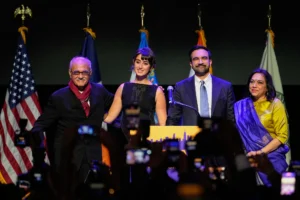
Zohran Mamdani with his family
Zohran Mamdani’s Victory in New York Echoes Far Beyond Its Borders
The phrase “Hawa Badal Rahi Hai” (The wind is changing) shows that people feel a big change is about to happen. This change is as desirable as dew, as vital as a drop of water in a desert. For many, this change was embodied in the symbolic victory of Zohran Mamdani, who, on November 4th, 2025, was projected to become the first Muslim mayor of New York City. As the son of Indian parents from Uganda, his win was celebrated not just as a personal achievement, but as a progressive milestone.
When these questions were put to the elderly man, he remained composed and replied
“I feel the change anyway, even with these problems. I’m hopeful. If it happens in America, it will happen in India too”.
JNU Election and Vote Theft in Indian Election
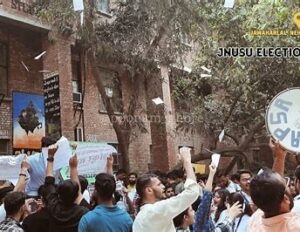
JNU Election, November 2025
He reflected that
“There is still reason to hope—and one sign of that hope came from the Jawaharlal Nehru University (JNU) student elections recent result, where Left-wing students won every seat, and the ABVP, backed by the RSS, suffered a complete defeat”.
He went on to note that
JNU has long been treated as a testing ground for the RSS’s Hindutva politics, especially through its student wing, the ABVP. For the ABVP, every victory there symbolized more than just a campus win—it was a step toward legitimizing their ideology nationwide. JNU, after all, mirrors India’s diversity in miniature; losing that ground, therefore, signals something deeper—a quiet but powerful resistance to the majoritarian narrative.
The elderly Muslim man’s steady hope of change seems to me like his belief in Almighty.
Does this mean JNU represents a battleground where success reflects what India truly wants? If yes, then why don’t we see similar results across the country?
At this point, it is important to note that JNU elections are conducted entirely by students. They use paper ballots, and the process is transparent—no manipulation, no cheating. In contrast, across India, Rahul Gandhi has repeatedly raised concerns before the national media about large-scale vote theft. Yet, there has been no investigation, no suo motu action from the Supreme Court—raising serious questions about the integrity of India’s institutions and democracy, now on display before the world.
Instances of such irregularities include wrongful deletions from voter lists in Bihar, disproportionately affecting marginalized and Muslim voters. A major cut in Muslim votes in the Seemanchal region, in Bihar has been reported. Similarly, allegations of vote theft emerged from places like Mahadevapura during the Karnataka state elections—claims that Rahul Gandhi brought to light. In Haryana too, he described the verdict as “stolen,” alleging fake votes—“one in eight,” he said. Despite these warnings, there remains a troubling silence. This suggests that India’s election outcomes do not always mirror its true diversity or the people’s mandate. Votes appear to be “made” to fit a narrative that benefits the ruling BJP.
Glimpse of Hope: Rahul Gandhi’s Mohabbat ki Dukan
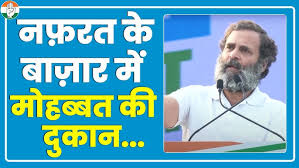
Congress Party’s poster highlights Rahul Gandhi’s message of choosing love over hate.
Yet, amid this bleak picture, there remains a faint glimmer of hope. The very exposure of electoral theft signals that all is not lost—it reveals that the present mandate does not truly mirror India. It means the country has not yet surrendered entirely to hatred or distortion. Injustice, no matter how entrenched, cannot endure forever. Sooner or later, people will find the courage to question, to resist, and to reclaim the secular, rational, and fraternal spirit that once defined India. These revelations, in their own quiet way, reassure us that diversity, coexistence, and love still survive beneath the surface.
This hope also finds expression in Rahul Gandhi’s vision of a “shop of love,” Mohabbat ki Dukan, a metaphor that captures his larger political mission. Long before others, India had its own “Mamdani”—a fearless voice who consistently spoke out against the politics of hate and the discriminatory, assimilationist agenda promoted by the RSS and its political arm, the BJP, under Prime Minister Narendra Modi since 2014. Unlike the Hindutva ideology that seeks to redefine India as a Hindu Rashtra—a state meant exclusively for Hindus across the world and inspired by Israel’s ethno-nationalist model that defines itself as the homeland of Jews—Rahul Gandhi’s politics firmly rejects such exclusivism. His vision stands in sharp contrast to it. He upholds and celebrates India’s pluralism, envisioning a nation where diversity is not merely tolerated but allowed to genuinely flourish.
When once asked about Rahul Gandhi marriage during his campaign for Bihar state election, he replied that he would do so “once his work is done” (The Economics Times, 2025). That “work,” as I understand it, is the effort to restore the integrity of India’s institutions and to rekindle the flower of diversity. India needs that mission to continue—because true change has not yet arrived. It requires strong and honest institutions, now under strain, and voices like Rahul Gandhi’s not just in every state, but in every district, to revive hope and safeguard the democratic soul of India. The 2025 Bihar state election will be a test of whether the phrase “Hawa Badal Rahi Hai” truly holds meaning—or whether it marks the victory of compromised and corrupt institutions that continue to feed on India’s democracy like parasites.
Reference:
The Economics Times (2025): Rahul Gandhi told me ‘will marry once my work is done’, claims young Bihar vlogger – The Economic Times, November 6, 2025
This article is really powerful and beautifully written. I liked how you showed both the pain and the hope that people still carry in their hearts. The part with the elderly men in Old Delhi was very touching and real.
Thank you for writing this with so much honesty and care. It reminds us that even in difficult times, hope, love, and truth still matter. Please keep sharing more articles like this. 🌿
Such a thoughtful article! Gives me hope that one day, India too will celebrate truth and justice — right after it finishes counting fake votes and arresting dissenters. 😅